Notes from the project.
Design notes, decisions and progress on Havenfold, an open-source core for the own cloud of a home or a small business. Written by the Havenfold team.
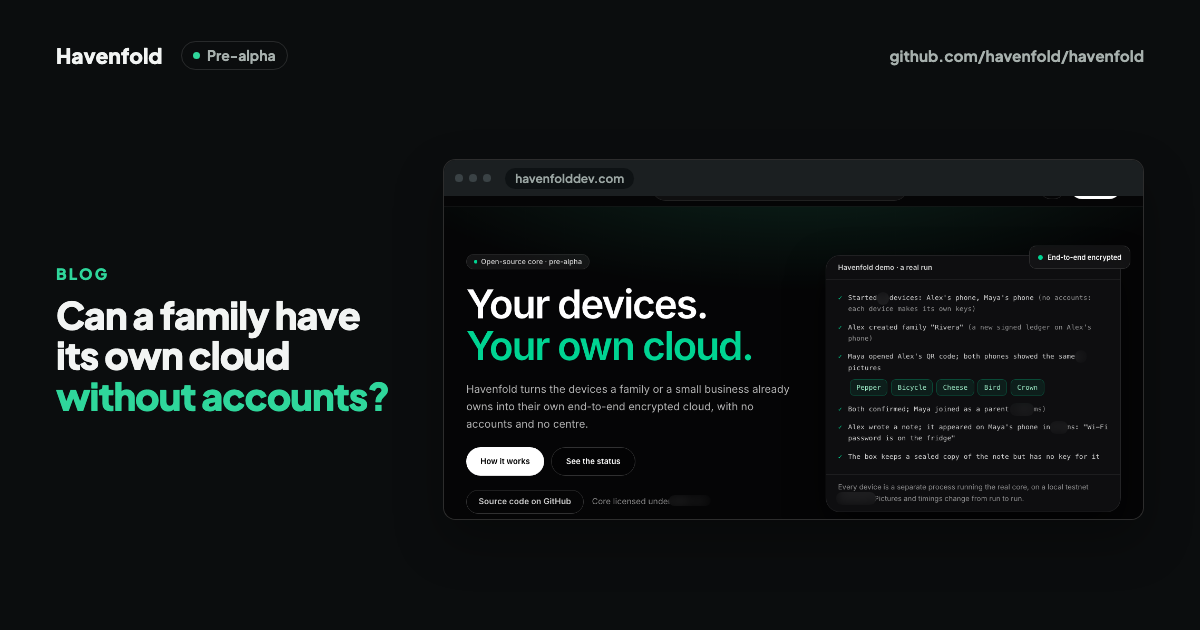
Can a family have its own cloud without accounts?
Havenfold is designed so that the devices a family already owns hold its data, people join face to face and no server knows who they are. Here is how that works, and why it is not ready for real data yet.
Read the post →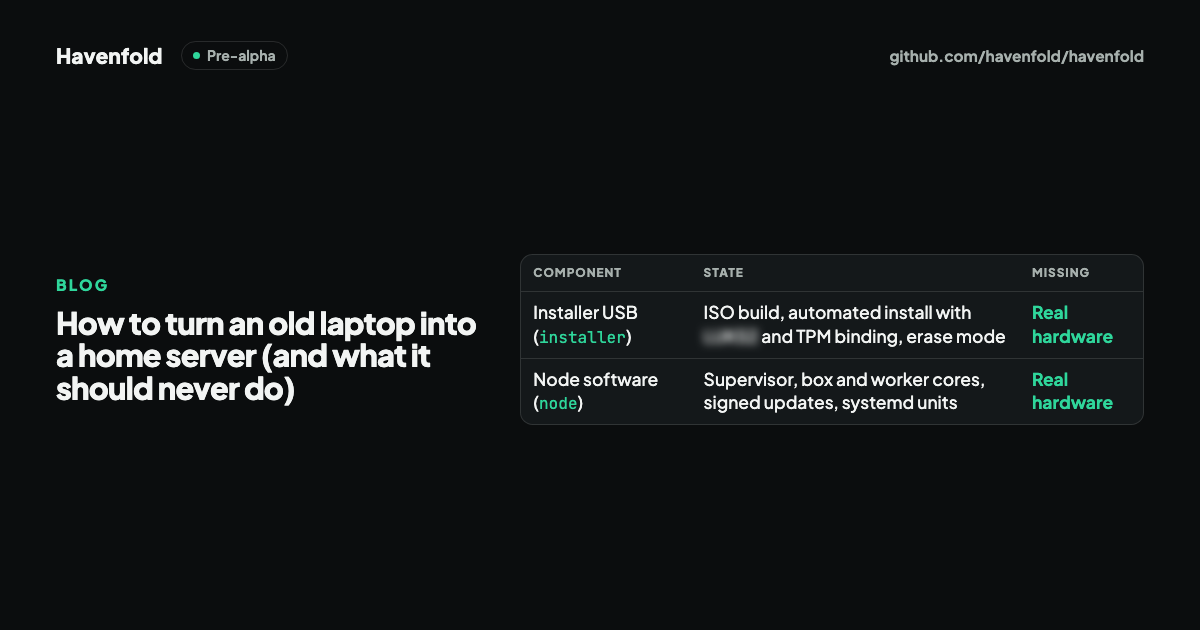
How to turn an old laptop into a home server (and what it should never do)
The general recipe for turning a spare laptop into a home server, the things it should never do, and how Havenfold's installer writes those choices down. Pre-alpha, tested only in a virtual machine.
Read the post →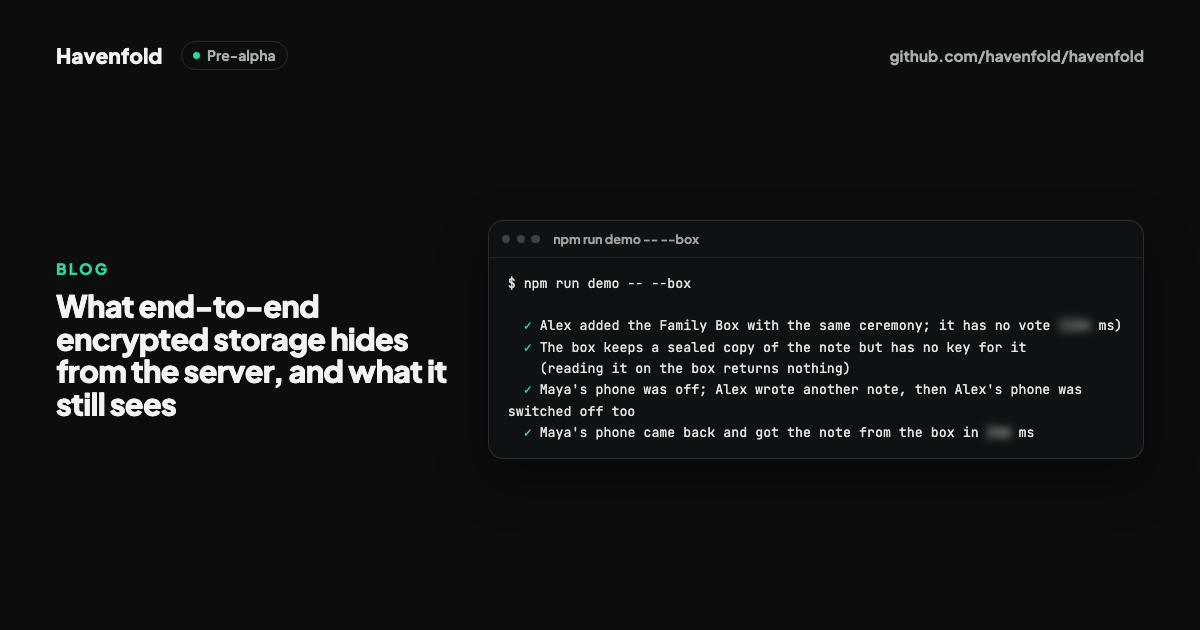
What end-to-end encrypted storage hides from the server, and what it still sees
End-to-end encryption keeps content readable only on your devices, but a server can still see timing, size, addresses and identity. Three questions to ask any 'zero-knowledge' storage, and Havenfold's answers. Pre-alpha.
Read the post →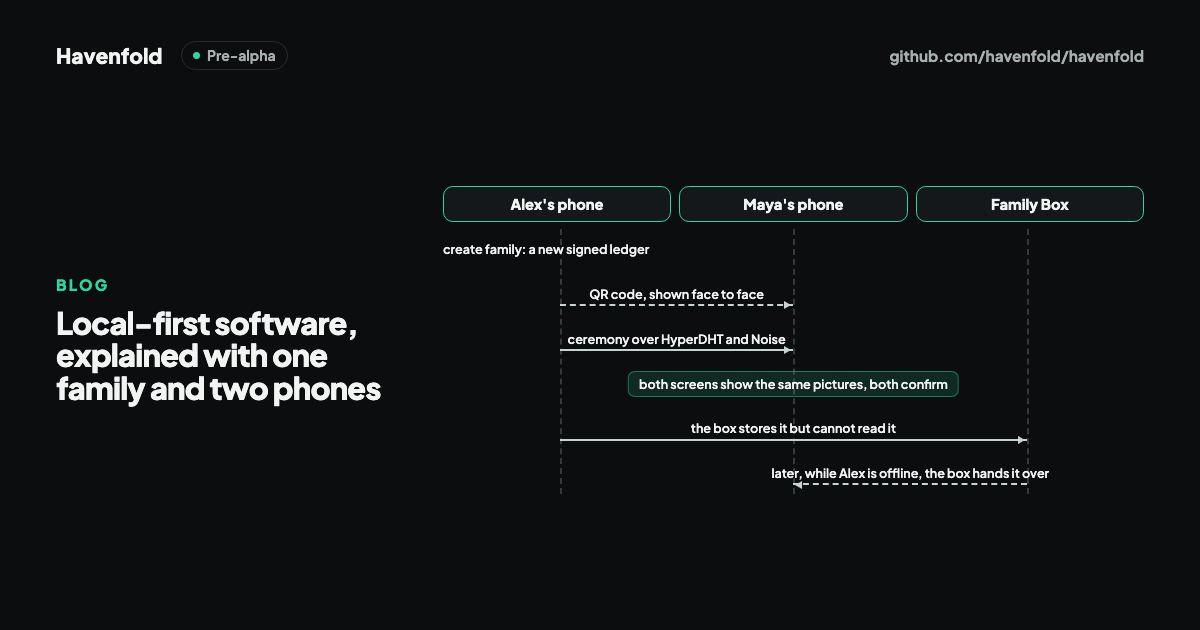
Local-first software, explained with one family and two phones
What local-first software means, the ideals from the Ink & Switch essay that named it, and where Havenfold stands on each, including what it has not solved yet. Pre-alpha.
Read the post →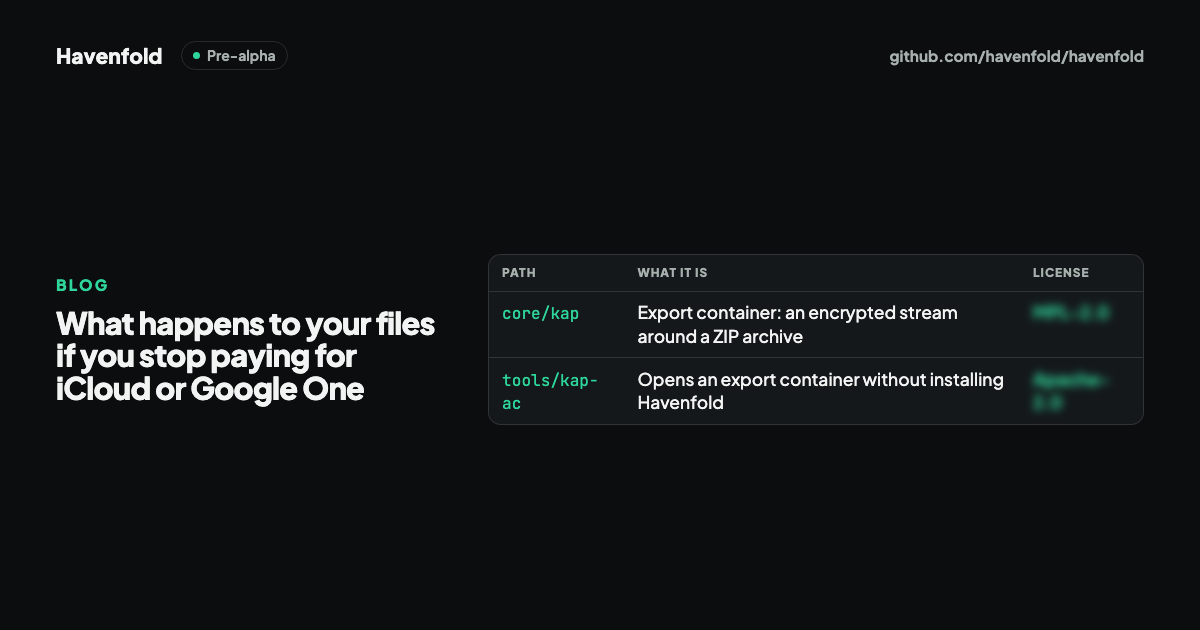
What happens to your files if you stop paying for iCloud or Google One
What Apple's and Google's own support pages say happens when you cancel or go over the free storage, a checklist before you cancel, and why the question matters to Havenfold. Pre-alpha; not a backup service today.
Read the post →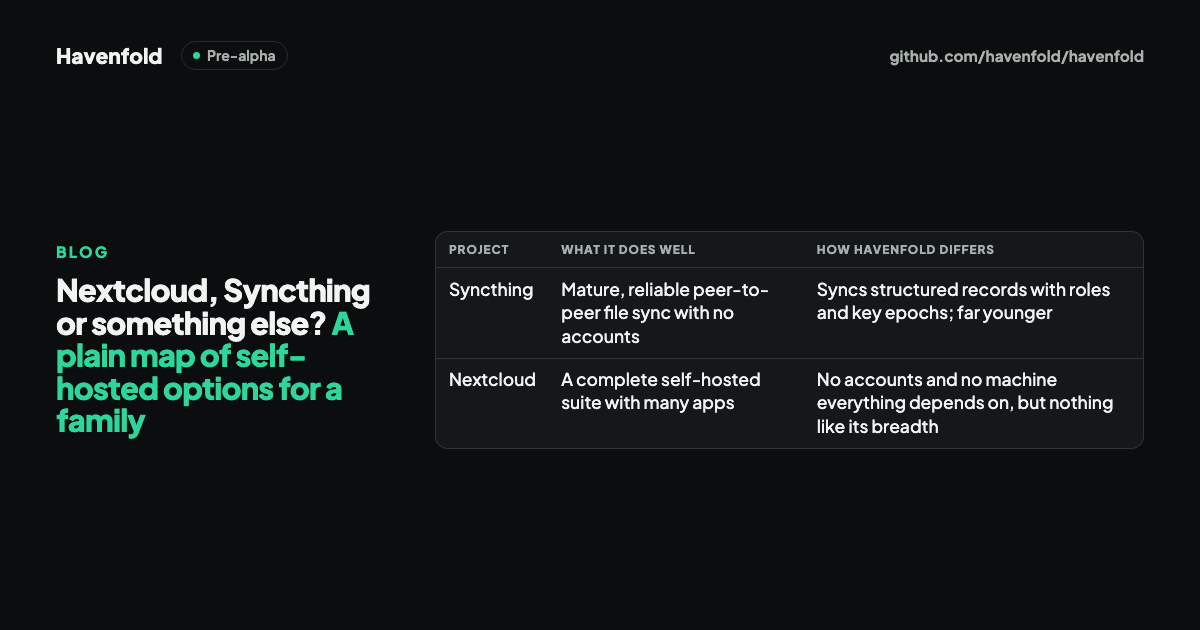
Nextcloud, Syncthing or something else? A plain map of self-hosted options for a family
What Syncthing, Nextcloud and Immich each do well, what they ask of you, and which family need they fit, plus an honest note on where Havenfold sits. Pre-alpha; not for real data.
Read the post →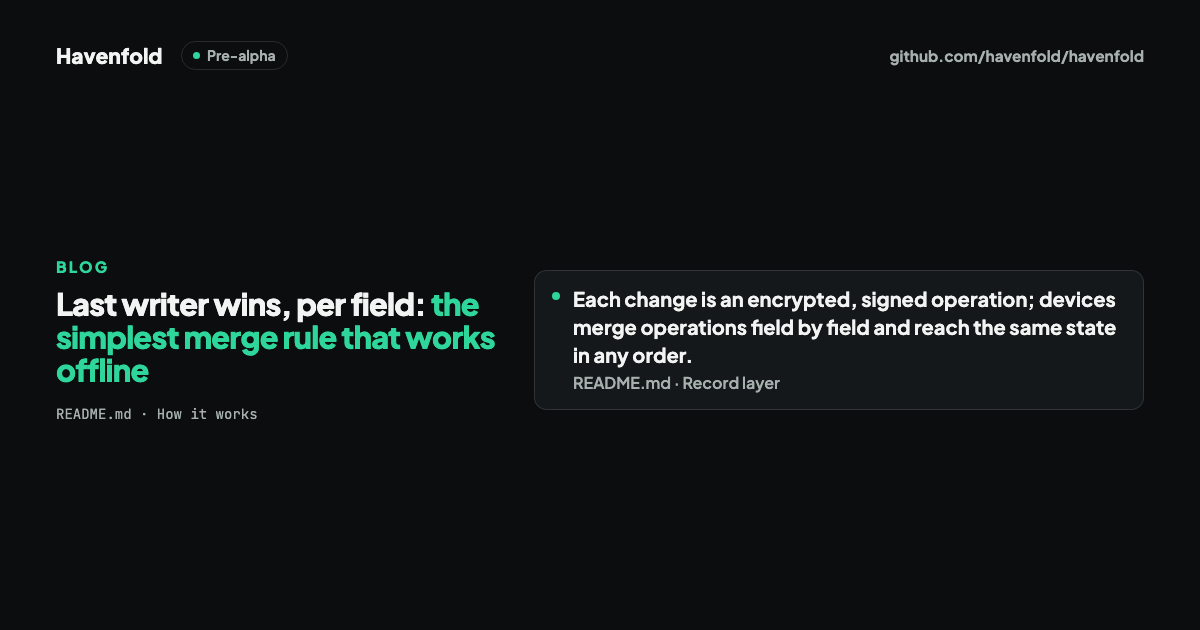
Last writer wins, per field: the simplest merge rule that works offline
How two offline devices can agree on the same data: operational transformation, CRDTs, the per-field last-writer-wins rule Havenfold uses with a hybrid logical clock, and where that rule breaks. Pre-alpha.
Read the post →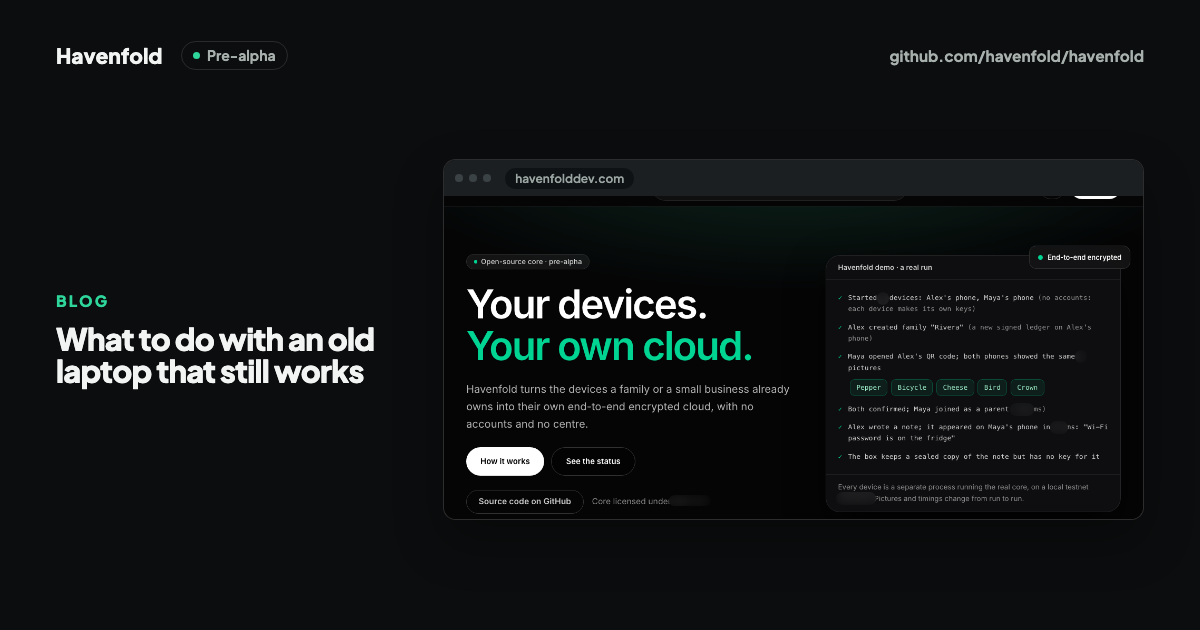
What to do with an old laptop that still works
Honest options for a laptop that still works, from giving it to someone who will use it to turning it into a small home server, and why you should back up and wipe it first either way. Havenfold is pre-alpha.
Read the post →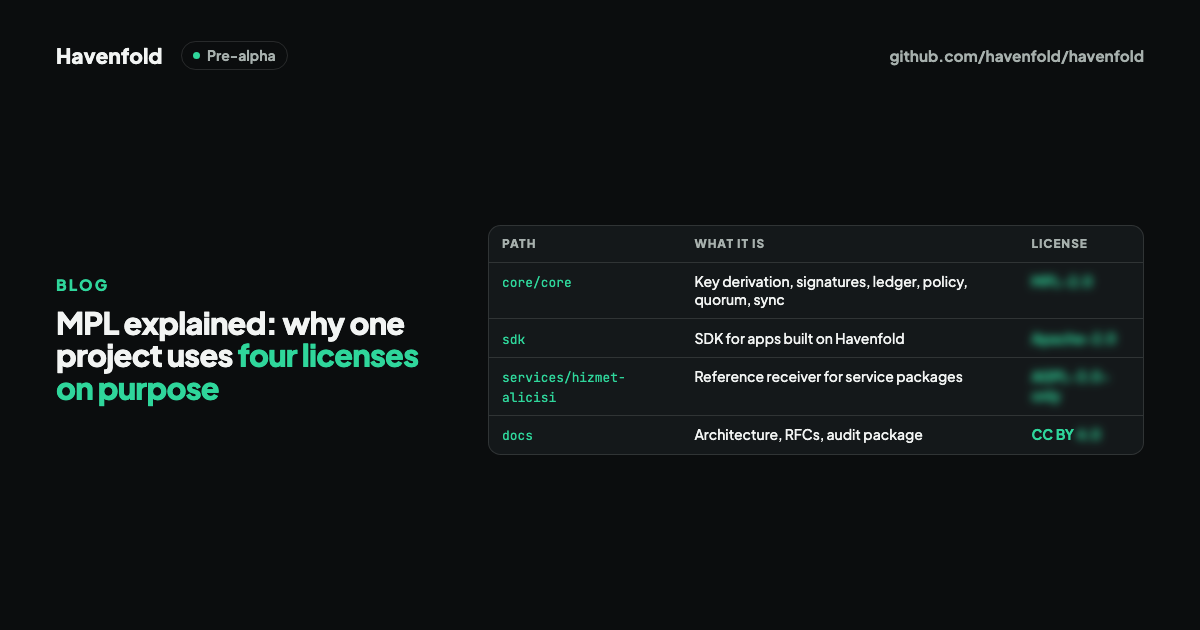
MPL-2.0 explained: why one project uses four licenses on purpose
What file-level copyleft means, how MPL-2.0 compares with Apache-2.0, the GPL, the AGPL and CC BY 4.0, and why Havenfold splits its repository across four licences on purpose.
Read the post →LUKS2 with TPM 2.0 auto-unlock on Ubuntu Server 24.04: what we automated and tested in a VM
How Havenfold's installer binds an encrypted Ubuntu Server disk to the TPM with Clevis, why PCR 7, the honest limit of that choice, and what was verified only in a virtual machine. Pre-alpha.
Read the post →How to wipe an old laptop before you give it away
Why deleting files isn't wiping, what NIST SP 800-88 covers, practical steps for Windows, Mac and Linux, SSD sanitize commands, and how Havenfold's erase mode approaches the problem. Pre-alpha; VM-tested only.
Read the post →Shamir secret sharing, explained with a lost phone
How Shamir secret sharing lets trusted people and devices rebuild a recovery key without any one of them holding it, how Havenfold's vault design uses it, and its honest limits. The vault is not released before an independent audit.
Read the post →Five pictures instead of a fingerprint: short authentication strings in practice
What a short authentication string protects against, why pictures, how Havenfold's joining ceremony derives them from the handshake, how remote joining works, and what the check doesn't protect against. Pre-alpha; unaudited.
Read the post →One JavaScript core, two runtimes: testing on Node.js and Bare
What Bare is, why one core beats two implementations, how Havenfold tests its core packages on Node.js and Bare, and a real timer difference the two-runtime testing surfaced. Pre-alpha.
Read the post →