Nextcloud, Syncthing or something else? A plain map of self-hosted options for a family
Havenfold team ·
If your family wants its files and photos off the big cloud services today, the mature self-hosted options do different jobs: Syncthing keeps folders in sync between your devices, Nextcloud is a full suite on your own server, and Immich is a photo and video library you run yourself. Havenfold is a different kind of project at a much earlier stage; it is pre-alpha and not something to put real family data on yet.
This post is a plain map: what each option does well, what it asks of you, and which family need it fits. It is written by the Havenfold team, so we have tried hard to be fair, and we start each entry with what the project does well.
First, decide what you actually need
"Self-hosted family cloud" can mean very different things. Before choosing a tool, answer three questions:
- Is the main job photos, files, or both? A photo library, a shared folder and a full office suite are different products.
- Who will look after it? Some tools need one person in the family who is comfortable running a server and updating it. Others mostly run on the devices you already use.
- Where will the second copy live? Any tool you run at home sits in the home. Whatever you choose, keep another copy of irreplaceable photos somewhere else.
Syncthing: keep folders the same on several devices
Syncthing describes itself as a "continuous file synchronization program" that "synchronizes files between two or more computers". It is mature, peer to peer, and needs no accounts. Its stated first goal is to be safe from data loss.
- Good fit: you want the same folders on a laptop, a desktop and a phone, without a central server.
- What it asks of you: some care setting up which folders sync to which devices. It syncs files; it is not a photo browser or a sharing portal.
- Keep in mind: sync is not backup. If a file is deleted or damaged on one device, sync can carry that change to the others, depending on your settings.
Nextcloud: a full suite on your own server
Nextcloud presents itself as an open-source file sync and share platform, and it has grown into a complete self-hosted suite with many apps: files, calendars, contacts, calls and more. It has desktop and mobile apps for the common platforms.
- Good fit: a family or small team that wants one place for files, calendars and sharing, and has someone willing to run a server.
- What it asks of you: a server, an administrator and user accounts. Someone has to keep it updated and secure.
- Keep in mind: the breadth is the strength and the cost. More apps mean more to maintain.
Immich: your own photo and video library
Immich describes itself as a "high performance self-hosted photo and video management solution". Its mobile app can back up photos from phones, including in the background, and it offers a familiar browsing experience.
- Good fit: the main goal is getting family photos and videos off a big cloud service into a library you control.
- What it asks of you: a machine at home to run it, and someone to look after updates.
- Keep in mind: Immich's own README says it plainly: "Always follow 3-2-1 backup plan for your precious photos and videos!" A self-hosted library is one copy, not your whole backup plan.
Where Havenfold sits, honestly
Havenfold is aiming at something different from all three: it turns the devices a family already owns into one end-to-end encrypted cloud with no accounts and no central machine. People join face to face; devices hold their own keys; a spare machine can keep sealed copies it cannot read.
Our own README compares Havenfold with these projects, and we'll quote it rather than spin it:
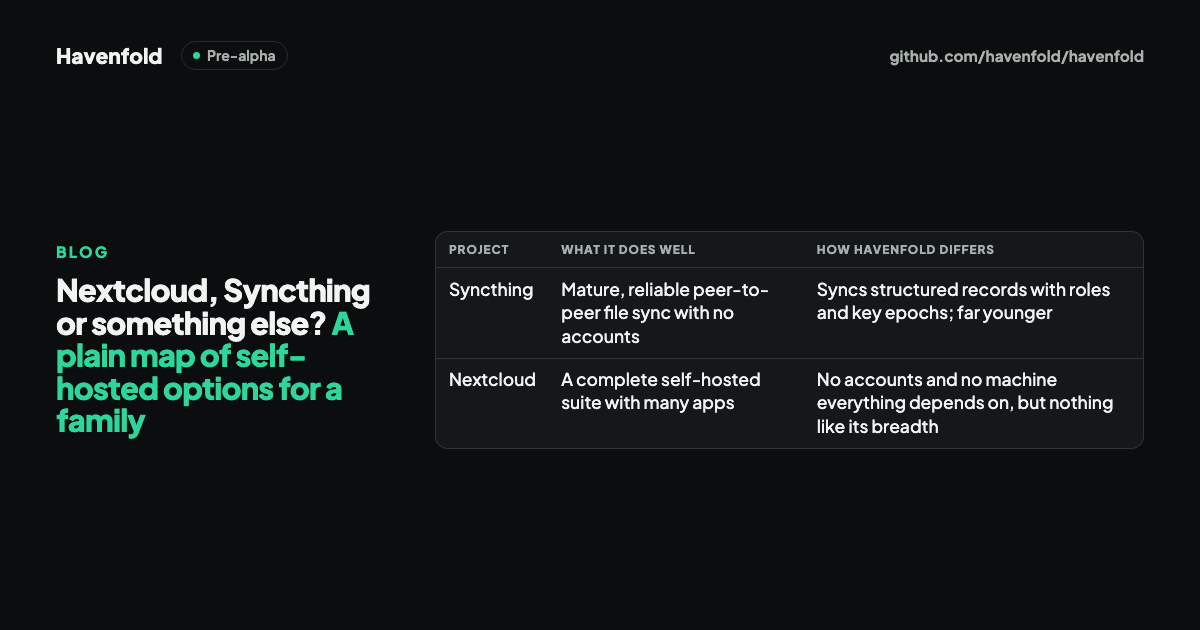
- On Syncthing: "Mature, reliable peer-to-peer file sync with no accounts." Havenfold syncs structured records with roles, permissions and key epochs, "it is far younger".
- On Nextcloud: "A complete self-hosted suite with many apps." Nextcloud needs a server, an administrator and user accounts; Havenfold has no accounts and no central machine, "but nothing like Nextcloud's breadth".
And the part that matters most for a family choosing today: Havenfold is pre-alpha. Do not use it for real data. It has not yet run in a real home, there has been no independent security audit, and it does not back up photos today. If you need a family cloud this month, choose one of the mature options above. If you are interested in where accountless, centreless family infrastructure could go, the design and code are open to read.
A simple way to choose
- "I want the same folders everywhere." Start with Syncthing.
- "I want one place for files, calendars and sharing, and someone in the family will run a server." Look at Nextcloud.
- "I want our photos and videos out of the big cloud." Look at Immich, and keep a second copy elsewhere.
- "I want to follow an early project that removes accounts and the central server." Read Havenfold's design, run the demo, and wait before trusting it with real data.
Summary
- Self-hosted "family cloud" covers different jobs: syncing folders, running a full suite, or keeping a photo library.
- Syncthing is mature peer-to-peer sync with no accounts; Nextcloud is a complete suite that needs a server and an administrator; Immich is a self-hosted photo and video library.
- Whatever you run at home, keep another copy of irreplaceable photos elsewhere.
- Havenfold aims at accountless, centreless family infrastructure, but it is pre-alpha, has no independent audit, does not back up photos today, and is not for real data yet.
Havenfold is pre-alpha: do not use it for real data. It has not yet run in a real home, and there is no independent security audit yet.
Sources