Can a family have its own cloud without accounts?
Havenfold team ·
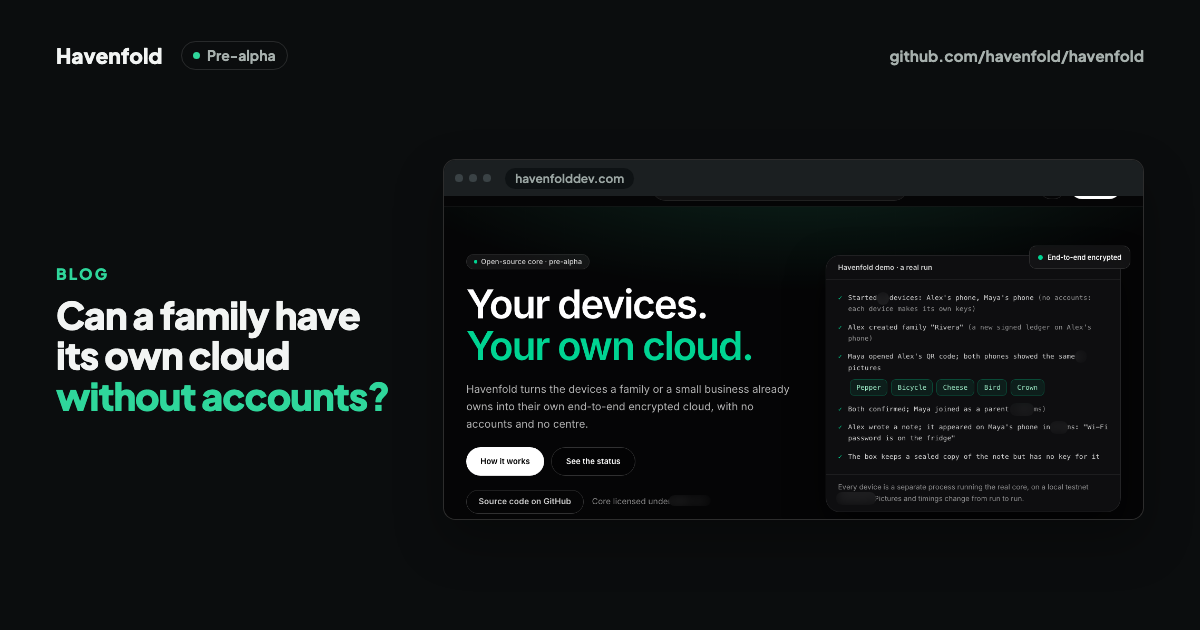
Yes, by design: Havenfold turns the devices a family or a small business already owns into their own end-to-end encrypted cloud, with no accounts and no centre. It is pre-alpha today, so it is not for real data yet, but the design and the code are open for anyone to read.
This post explains the problem Havenfold starts from, the ideas that make a cloud without accounts possible, what Havenfold deliberately is not, and where the project honestly stands.
A drawer of devices that still work
Most homes and small shops have an old laptop, a retired phone or a tablet nobody uses. Meanwhile their photos, documents and passwords live with cloud companies. When a company shuts a service down or raises its prices, the data goes with it or becomes expensive to keep.
The usual answer is another account with another company. Havenfold asks a different question: what if those spare devices, together with the family's phones, were the family's own cloud?
What "no accounts" really means
In most cloud products, you are a row in a company's user table. Your identity lives on their server, and so does the power to reset your password, lock you out or read what you store.
Havenfold moves identity to the device:
- Identity lives on the device. Each device makes and keeps its own keys. There are no user accounts on any server.
- No sign-up, no password reset. There is no server that knows who you are.
- Even we cannot see your content, and we do not know who you are.
Without accounts, a family needs another way to decide who belongs. That is the job of the ceremony.
Joining face to face
People join a community, a family or a team, in person. A member's phone shows a QR code, the newcomer scans it, and both screens show the same short set of pictures. If the pictures match, both people confirm, a parent signs, and the joining is written into the community's signed ledger.
Devices join through the same ceremony, but they never vote. A spare laptop can store and work for the family; it cannot decide who the family is, and a stolen device cannot take the community over.
Joining in person is slower than clicking an invite link, on purpose. Trust starts where families already build it: in the same room.
No centre
Inside a Havenfold community there is no main device, no main server and no main node. When a device is switched off, lost or stolen, the community keeps working.
Devices share work, but Havenfold never pretends they are a single giant computer. Each task runs on a single device, and the largest task a community can run is always shown, so nobody is promised more than their devices can do.
Sealed end to end
Content is end-to-end encrypted. Relay services that help devices reach each other only carry sealed envelopes; they cannot open them.
Havenfold does not invent its own cryptography. It uses libsodium and the widely used Holepunch libraries, with well-known algorithms. New protocol design goes to independent review.
What Havenfold is not
Being clear about limits matters as much as listing features:
- Not a cluster operating system. It does not merge the memory and processors of several devices into a single machine.
- Not a cloud service. Data stays on the community's own devices. A cloud provider is only an optional accelerator that the user chooses.
- Not an account system. There is no sign-up and no server that knows who you are.
- Not a surveillance tool. Adults cannot be monitored in secret. There is no face recognition database and no per-employee tracking.
- Not a new cryptosystem. It relies on existing, well-known building blocks.
Where it stands today
Havenfold is pre-alpha: do not use it for real data. Interfaces and formats may change without notice until the first tagged release.
- The core layers (the membership ledger and ceremony, records, tasks, events) are written and tested on Node.js and Bare, including multi-device tests on a local test network.
- The installer USB has been built and installed end to end in a virtual machine on GitHub Actions; it has not been tried on real hardware yet.
- Havenfold has not yet run in a real home, and there is no independent security audit yet.
- The design is written down in design documents (RFCs). "Approved" on an RFC means approved by the project owner alone.
So the honest answer to "what can I install at home today?" is: nothing ready for a family yet. The phone apps are separate, closed products and are not in the open repository. Yuva's Defteri, Acil, Pati and Bakım apps are built on the Havenfold core.
Open core, written promises
The core is open source and published under the Mozilla Public License. The SDK and test vectors use the Apache License, the server-side reference code uses the GNU Affero General Public License, and the documentation uses Creative Commons Attribution.
The project also makes written promises:
- Published code will not be relicensed under a more restrictive license.
- If the project is sold, the trademark and the repository go to a foundation.
- No patent applications: innovations are published openly. Contributions use the DCO; there is no CLA.
You can read the code, the design documents and the status table in the repository on GitHub, or start from the overview on this site.
Summary
- A family cloud without accounts is possible by design: identity lives on each device, and no server knows who you are.
- People join face to face with a QR code and matching pictures; devices join the same way but never vote.
- There is no centre: losing a device does not stop the community.
- Content is end-to-end encrypted, and relays carry only sealed envelopes.
- Havenfold is pre-alpha. It has not run in a real home and has no independent security audit yet, so do not use it for real data.
Havenfold is pre-alpha: do not use it for real data. It has not yet run in a real home, and there is no independent security audit yet.
Sources